


Friday, August 23, 2024
Hello everything is fine?
In this edition of the newsletter, we share about ISER’s progress in agendas for a more just society committed to climate justice. ISER was present at the G20 Interfaith Forum in Brasília. In the last few days, we also had the closing of the second edition of Boto Fé no Clima.
You will also see: Chat with anthropologist and ISER advisor Rosana Pinheiro-Machado; (Im)pertinent Dialogues on Christian Nationalism; Visit of the director of the International Association on Religion and Sustainable Development (PaRD); Launch of the Rights Agenda and ISER in the media.
Did you receive this newsletter from someone else and want to have yours? Fill out the form on the website.
ISER present at the G20 Interfaith Forum
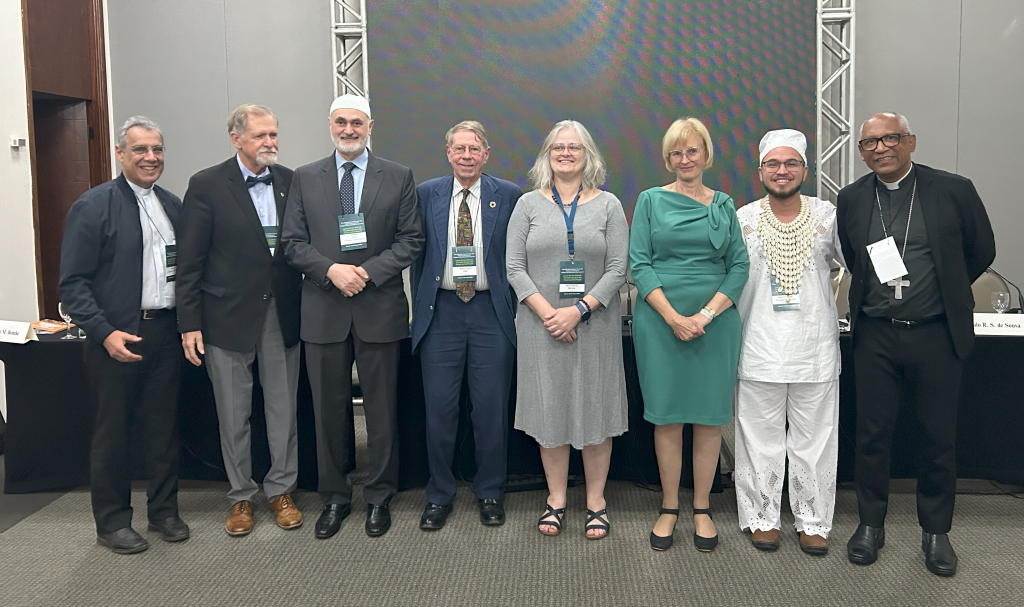
From August 19 to 22, ISER was present at the G20 Interfaith Forum (IF20) in Brasília, a body that seeks global solutions by bringing together religious thought leaders and political representatives to help shape the overall G20 agenda.
Paulo Sampaio, coordinator of the Environment and Religion area, participated in the event, especially in the session on Lessons from Religious Defense of the Environment: Laudato Si, Al Mizan, and provided a global overview of the environmental journey. He highlighted the religious participation in this journey, situating the contributions of ISER and partners in these efforts regarding climate and environmental issues.
In addition to Paulo, the panel was attended by Pastor Romi Márcia Bencke, General Secretary of the National Council of Christian Churches of Brazil (CONIC), the President of the International Environmental Forum Arthur Lyon Dahl, the President of the Latin Arab Center for Culture and Strategic Studies (CALCEE) Sheikh Jihad Hassan Hammade, the Historian of IF20 Sherrie Steiner and the Archbishop of the Archdiocese of Feira de Santana Dom Zanoni Demettino.
The panel was moderated by James Taylor Christie, Ambassador of the Canadian Multi-Religious Federation and Father Marcus Barbosa, Advisor to the Commission for Ecumenism and Inter-religious Dialogue of the National Conference of Bishops of Brazil.
Youth of faith and climate action: Another group of students from the Boto Fé no Clima training program

Over the past three months, our Faith in the Climate project has brought together young people from all over Brazil to think about ways to bring climate action to their faith communities.
Combining the foundations of their spirituality with knowledge about climate and engagement, the youth of faith were challenged to think of practical actions to raise awareness in their religious spaces about environmental and climate issues.
Last Wednesday, the second cycle of Boto fé no Clima came to an end! Now, the young people are moving on to developing their final projects. There are more than 30 different proposals to be published on networks and territories by November 2024, ranging from discussion groups, creation of vegetable gardens and gardens of sacred plants, citizen generation of data, including the production of documentaries and the establishment of waste collection initiatives.
More than a training, the Boto Fé no Clima contributes to the engagement of people of faith in the climate agenda and the promotion of climate justice in their territories!
“Informal work, digital marketing and the far right” – a conversation with Rosana Pinheiro-Machado

On Wednesday, August 14, anthropologist and ISER advisor Rosana Pinheiro-Machado was present at our office for a chat about her work and knowledge production on the digital economy, neoliberalism and the far right. including the theme of religion transversally.
The researcher provided a comprehensive look at the job market in the internet age and how digital marketing, especially the promotion of betting platforms, is linked to the current aesthetic standard and is already part of the daily lives of Brazilians. The researcher gave us an analytical look at the connection that has been drawn between informal work and far-right movements.
Rosana Pinheiro-Machado has been part of the ISER Deliberative Council since 2023 and has produced essential research to contribute to the understanding of new labor relations in the Brazilian context.
Christian nationalism: interfaces between Brazil and the United States

Last Thursday (22/08), another edition of ISER's (Im)pertinent Dialogues took place.
This time, the teachers were with us Raymond Barreto, Princeton University Theological Seminary, and John Chaves, from Baylor University – Texas, and Erika Ramirez, from Auburn Theological Seminary, New York, to deepen the debate on how Christian nationalism has been recognized as one of the main threats to democracy in the United States and, mainly, how Brazil and the United States influence each other in this articulation of radicalization and extremism.
More than Christian nationalism, the researchers expanded the focus to religious nationalism, highlighting that A similar phenomenon bringing together themes of nationalism, politics and religion occurs in other countries and different religions, such as Buddhism and Hinduism.. The commitment is to continue this dialogue between Brazil and the United States.
New Evangelical Narratives launches Christian Justice Agenda 2024

ISER participated in the launch of the Christian Justice Agenda of New Evangelical Narratives represented by the Coordinator of Religion and Politics Livia Reis and by Luciana Petersen, Communications Coordinator and also Co-executive director of New Narratives. The launch took place on August 14th, in Rio de Janeiro, and brought together pre-candidates, activists and leaders of the Christian democratic field.
During your participation, Livia presented a current analysis of ISER research that provides data on elections and evangelical women.
The Christian Justice Agenda was created with the opportunity to develop a political project that is based on Christian values to encourage the fight for rights among the Christian public, especially evangelicals, and brings together six programmatic axes considered fundamental to improving the living conditions of the Brazilian population: anti-racism; environment and climate; defense of democracy and human rights; fight against hunger and poverty; gender equality and women's rights; rights of the LGBTQIA+ population.
Director of the International Association on Religion and Sustainable Development visits ISER

On August 15, ISER received the Director of the International Association on Religion and Sustainable Development (PArD) Khushwant Singh for a dialogue on religion, public space and the environment. PArD is an international organization that brings together governments, organizations, universities, religious actors and other civil society actors to enhance contributions to the long-term Sustainable Development Goals.
During his visit to Brazil, Khushwant Singh was looking for organizations that could help him understand the Brazilian context and was recommended ISER! Our conversation revolved around our work and confluences on politics, religion, security and socio-environmental issues.
ISER in the media

Have you heard about the impacts of religious identities on municipal elections? This is what ISER researcher Magali Cunha discusses in an article published by CartaCapital.
In the text, Magali talks about the ultraconservative Catholic activism of recent years and highlights the studies published by ISER on Catholic reactionism focusing on neoconservative movements classified as “legal catholicisms”.
“While, on the one hand, official candidacies supported by evangelical churches continue to have good results at the polls, they do not always mobilize religious names at the polls. On the other hand, candidates who are not religious have begun to identify themselves as Christians – in a generic way – to communicate to the electorate the set of values with which they identify or to ask for votes in small and medium-sized churches, which do not have their own official candidacies.”
[Agência Brasil] Applications with religious identity grow by 225% in 24 years
Lívia Reis, coordinator of Religion and Politics at ISER, also contributed to an article on the same topic in Agência Brasil, with data from ISER's research on elections that have mapped candidacies with religious identities since 2018.
To receive the bi-weekly newsletter in your email, register here!